Walk into the treasury department of any large corporation and ask what they expect from their capital. You will get a precise answer — how much yield, how much earnings growth, how much money will reach the bottom line, and over what period.
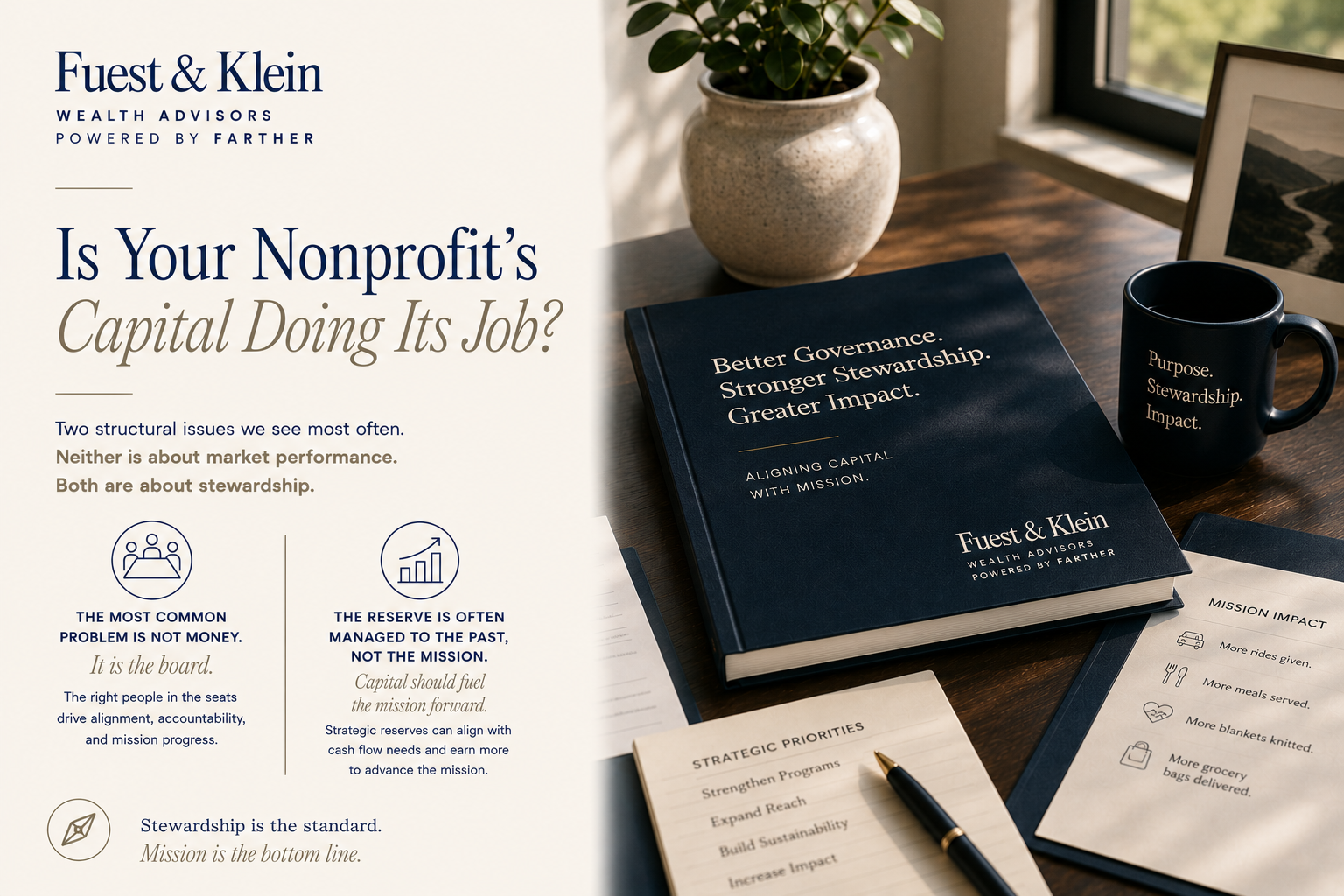
A nonprofit deserves the same discipline. The difference is what the bottom line measures. In a nonprofit, the bottom line is mission. How many more rides given. How many more meals served. How many more blankets knitted, how many more grocery bags delivered. If the organization’s capital is not adding incremental mission — on top of everything fundraising already brings in — the capital is not doing its job.
In our work with nonprofit boards and executive directors, two structural issues come up more than any others. Neither is about market performance. Both are about stewardship.
The Most Common Problem Is Not Money. It Is the Board.
The single most common pain point we encounter is this: the right people are not in the seats. Many boards are built from constituents who donated money, and the board seat came with the check. The generosity is real and it matters. But a check is not a qualification to govern.
What an organization needs is an operating board, not an advisory board. Real progress happens when everyone in the room is aligned and moving in a direction they want to be moving in — not one that is forced. That only works when each seat is filled deliberately.
Save Space for Check Writers — Just Not Voting Seats
There is a structure that honors early donors without compromising governance. Place the founding check writers on a non-voting advisory board. They stay close to the mission, volunteer as much as they want, and remain valued partners of the organization.
The operating board, meanwhile, does something different. It builds a list of what the organization needs accomplished — short term, medium term, and long term — and then goes out and recruits people with those specific skills. Those are tangible skills found across industries, and they are rarely check-writing skills. When the right people are in the room, they do not need the organization to create every outcome. They collaborate. They refer. They build on each other. The board’s job is to get the right people there — and then move the mission forward together.
The Reserve Is Often Managed to the Past, Not the Mission
The second issue lives in the strategic reserve or private foundation account. Too often, these funds are not managed to the organization’s actual cash flow needs. They are managed to what the organization needed at the very beginning of its life — emergency savings. The result is a large amount of cash sitting in unnecessarily conservative instruments: CDs, short-term money markets.
A portfolio can be structured far more strategically. It can align with the organization’s monthly, quarterly, and semi-annual cash flow needs while remaining liquid enough for genuine emergencies. The board and the executive director keep full flexibility to drive the mission — and the capital earns what it should be earning along the way.
Every Voting Member Is a Fiduciary
For nonprofit organizations, fiduciary is the highest standard of care — put very simply. And many board members do not realize that this standard carries personal liability. Not just for the treasurer. For every voting member. Any voting member has a say in the organization’s finances, and that say should be heard whenever something financial is on the table.
The standard itself is clear: donor capital must be put first — toward the mission — before any need or requirement of an employee or a board member. Understanding that duty is not optional. It is the job.
Why Three to Five Million Matters
A strategic reserve or foundation account in the range of $3–5 million is a critical threshold for an operating charity. That is the point where capital develops real mass — where investments can genuinely grow the organization, and where programs can begin to be funded through distributed earnings rather than fundraising alone. Every dollar of earnings deployed well is incremental mission that no gala had to produce.
The Questions Every Board Should Be Asking
A board should be asking its financial advisor: Why are we invested in what we are invested in? Is it appropriate for this organization, at this time — especially if nothing has changed in the past 18 to 24 months? And what should it look like over the next 18 to 24 months, assuming the mission grows, the account grows, and the cash flow changes with them?
This should be a regular, two-way conversation — a genuinely symbiotic relationship between the board and its advisor about maximizing what the reserve can do for the mission. And the test is measurable: over a three-to-five-year period, a well-managed strategic account should incrementally increase the amount of mission delivered, in addition to fundraising and every other initiative. If it is not, the capital is not being deployed properly.
One Question to Take to Your Next Board Meeting
If you serve on a nonprofit board, ask yourself one thing: when was the last time your wealth advisor asked to sit down and review everything — to make sure the organization and its capital are in strategic alignment?
If you cannot remember, that is the conversation to have. We would welcome having it with you.
Start a Conversation → Schedule an Introduction
How Nonprofits Waste Their Most Powerful Asset
All opinions and views expressed by Farther are current as of the date of this writing, are for informational purposes only, and do not constitute or imply an endorsement of any third-party’s products or services.
The information provided does not take into account the specific objectives, financial situation, or the particular needs of any specific person and therefore should not be relied upon as investment advice or recommendations. Neither does it constitute a solicitation to buy or sell securities, nor should it be considered specific legal, investment or tax advice.
Finally, investing entails risk, including the possible loss of principal, and there is no assurance that any investment will provide positive performance over any period of time.