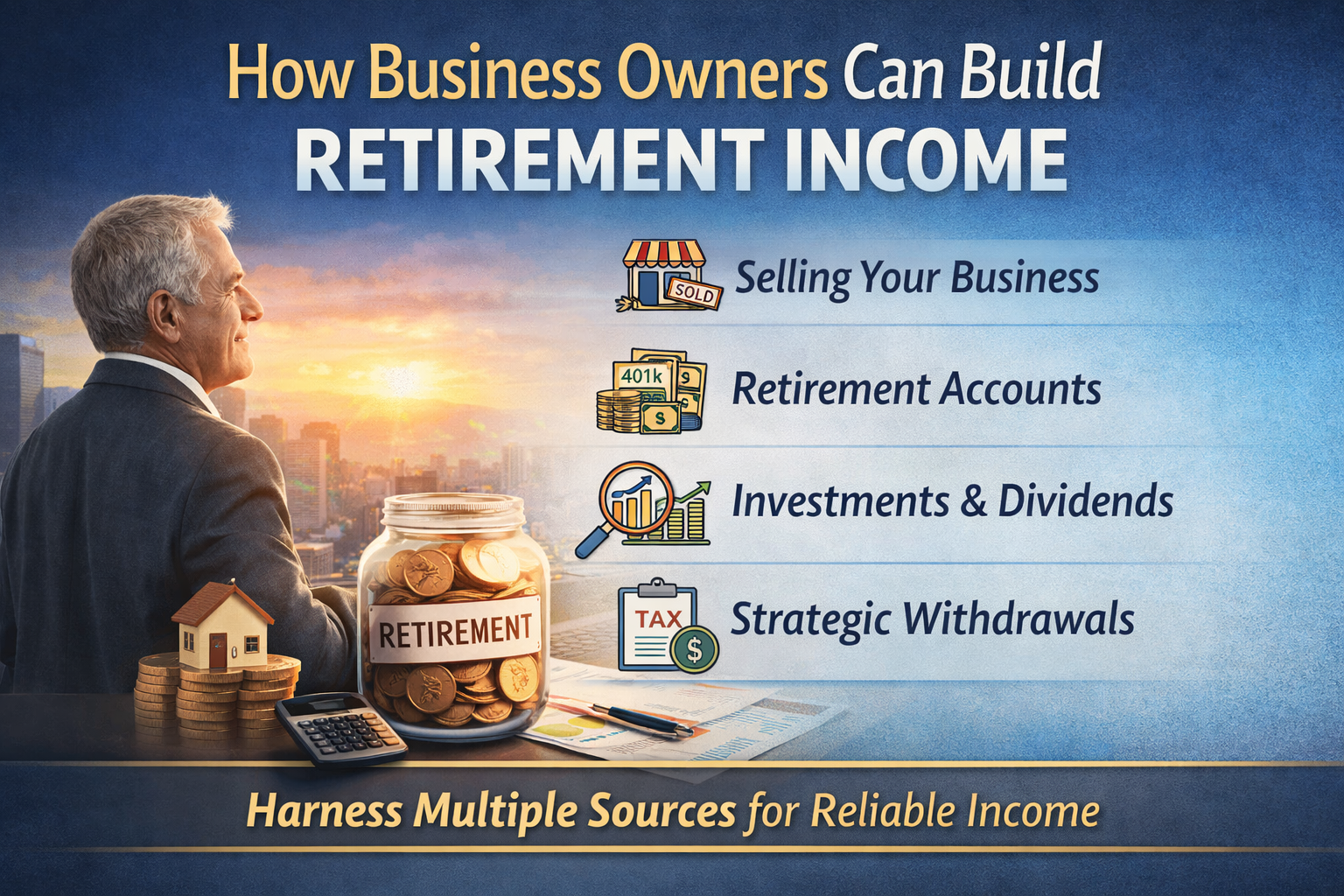
For business owners, retirement income is not always straightforward.
Unlike traditional employees with structured retirement plans, entrepreneurs often rely on multiple sources—business value, investments, and strategic planning—to generate income in retirement.
The goal is not just to accumulate wealth, but to convert that wealth into a reliable and sustainable income stream.
Understanding Retirement Income for Business Owners
Building retirement income requires a shift in mindset.
During your working years, the focus is on growth—expanding the business, increasing revenue, and reinvesting profits.
As retirement approaches, the focus shifts toward:
- Stability
- Predictability
- Income generation
This transition is critical for long-term financial security.
Key Sources of Retirement Income
Business owners typically rely on a combination of income sources.
1. Business Exit or Transition
For many entrepreneurs, the business itself is the largest asset.
Options may include:
- Selling the business
- Transitioning ownership
- Creating ongoing income through structured payouts
A well-planned exit can become a primary income source.
2. Retirement Accounts
Strategic use of retirement plans helps create long-term income.
These may include:
- 401(k) plans
- SEP IRA
- Cash Balance Plans
Consistent contributions over time build a strong financial foundation.
A Strategic Reality: Income Doesn’t Happen Automatically
Many business owners assume that once they stop working, income will naturally follow.
In reality, retirement income must be intentionally designed.
Without a structured plan:
- Income may be inconsistent
- Tax exposure may increase
- Assets may not be used efficiently
Retirement is not just a phase—it’s a financial system that needs to be built.
Investment-Based Income
Investments play a key role in generating income.
This may include:
- Dividend-producing assets
- Interest-bearing investments
- Portfolio withdrawals
The goal is to create a balance between income and long-term sustainability.
Tax-Efficient Withdrawal Strategy
How you withdraw income matters just as much as how you build it.
A structured withdrawal plan can help:
- Reduce tax burden
- Extend the life of your assets
- Improve overall income efficiency
Poor withdrawal strategies can significantly impact long-term outcomes.
Common Mistakes to Avoid
Business owners often:
- Rely too heavily on selling the business
- Delay income planning until retirement
- Ignore tax implications
- Lack diversification in income sources
These can lead to uncertainty and financial gaps.
The Role of a Financial Planning Advisor
Working with a financial planning advisor helps ensure that your retirement income strategy is aligned and sustainable.
This includes:
- Coordinating multiple income sources
- Structuring tax-efficient withdrawals
- Aligning investments with income goals
A clear plan turns assets into income with intention.
When to Start Planning
The best time to plan retirement income is:
- 5–10 years before retirement
- Before any business transition
- When income and assets begin to scale
Early planning allows for flexibility and better outcomes.
Final Thoughts
Building retirement income as a business owner requires more than saving—it requires strategy.
By combining business value, investments, and structured planning, it’s possible to create a reliable income stream that supports long-term financial clarity.
The key is planning ahead and aligning each decision with your long-term vision.
Post Disclaimer
All opinions and views expressed by Farther are current as of the date of this writing, are for informational purposes only, and do not constitute or imply an endorsement of any third-party’s products or services.
The information provided does not take into account the specific objectives, financial situation, or the particular needs of any specific person and therefore should not be relied upon as investment advice or recommendations. Neither does it constitute a solicitation to buy or sell securities, nor should it be considered specific legal, investment or tax advice.
Finally, investing entails risk, including the possible loss of principal, and there is no assurance that any investment will provide positive performance over any period of time.