There’s a retirement savings strategy that could shelter up to $300,000 of your business income from taxes — every single year. Most small business owners have never heard of it. That’s not an accident.
The Product Nobody’s Selling You
Defined benefit pension plans (also called cash balance plans) are among the most powerful retirement tools available to small business owners. They’re also among the most underutilized.
Why? Because they require patience — from the advisor and the client.
Most financial professionals gravitate toward simpler products. A SEP IRA is easy to explain in a 20-minute meeting. A defined benefit plan takes longer to understand, longer to set up, and longer to see results. That lead time is enough to push most advisors toward the path of least resistance.
The business owners who do take the time to understand these plans tend to become their biggest advocates. Because the math is hard to argue with.
What You’re Actually Getting
Here’s how a typical savings progression might look for a small business owner:
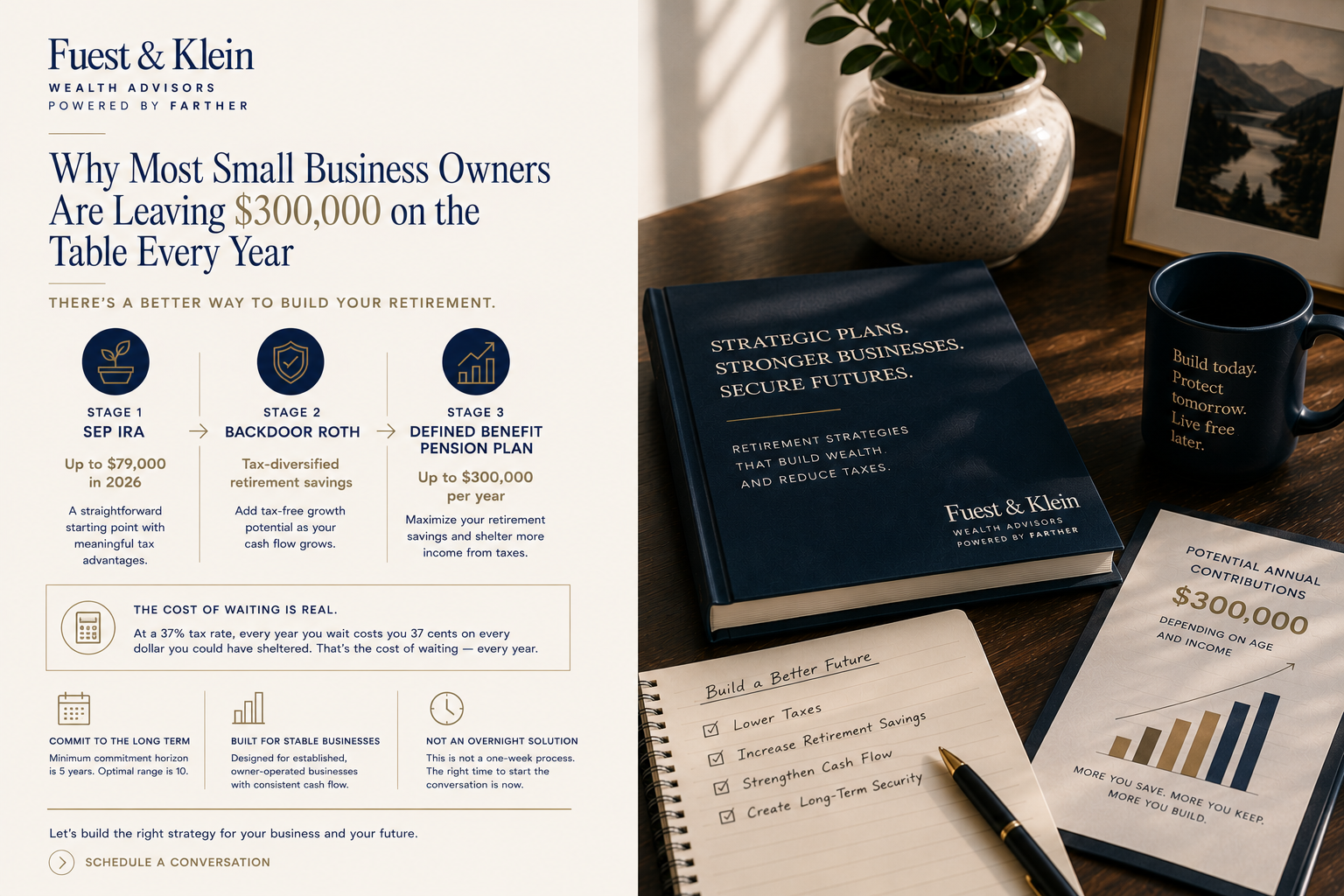
Stage 1 — SEP IRA A straightforward starting point. In 2026, you can contribute up to $79,000 annually. Simple to establish, and a meaningful tax advantage on its own.
Stage 2 — Backdoor Roth As cash flow grows, layering in a backdoor Roth adds tax-diversified retirement savings — money that grows and distributes tax-free.
Stage 3 — Defined Benefit Pension Plan When the business has stable, consistent cash flow, this is where the real leverage begins. Depending on the business owner’s age and compensation structure, contributions can reach $300,000 per year — coming directly off gross business income before taxes.
That last number deserves a moment. If your business is paying a 37% tax rate, every year you delay a defined benefit plan costs you 37 cents on every dollar you could have sheltered. That’s the cost of waiting — not a one-time fee, but a recurring annual loss.
Is This Right for Your Business?
A defined benefit plan makes sense when a business owner has enough consistent cash flow to fund the plan consecutively — meaning you can commit to contributions year over year, not just when it’s convenient.
The minimum commitment horizon is five years. The optimal range is ten.
This isn’t a strategy for early-stage businesses or owners in volatile cash flow situations. It’s built for established, owner-operated businesses with stable revenue and a long-term mindset about building wealth.
If that describes you, the question isn’t whether a defined benefit plan is worth exploring. It’s how much you’ve already left behind by not starting sooner.
One More Thing Worth Knowing
This is not a one-week process. Setting up a defined benefit plan involves coordination, documentation, and compliance. It takes time to do correctly — which is exactly why the right time to start the conversation is before you feel urgent about it.
Fuest & Klein works with small business owners who are serious about building retirement security through the right structures at the right time. If a defined benefit pension plan sounds like it might be the right fit for your business, we’d welcome a conversation.
All opinions and views expressed by Farther are current as of the date of this writing, are for informational purposes only, and do not constitute or imply an endorsement of any third-party’s products or services.
The information provided does not take into account the specific objectives, financial situation, or the particular needs of any specific person and therefore should not be relied upon as investment advice or recommendations. Neither does it constitute a solicitation to buy or sell securities, nor should it be considered specific legal, investment or tax advice. Finally, investing entails risk, including the possible loss of principal, and there is no assurance that any investment will provide positive performance over any period of time.
Post Disclaimer
All opinions and views expressed by Farther are current as of the date of this writing, are for informational purposes only, and do not constitute or imply an endorsement of any third-party’s products or services.
The information provided does not take into account the specific objectives, financial situation, or the particular needs of any specific person and therefore should not be relied upon as investment advice or recommendations. Neither does it constitute a solicitation to buy or sell securities, nor should it be considered specific legal, investment or tax advice.
Finally, investing entails risk, including the possible loss of principal, and there is no assurance that any investment will provide positive performance over any period of time.