Choosing the right retirement plan is one of the most important financial decisions a business owner can make.
With multiple options available, including 401k vs SEP IRA vs Cash Balance Plan for Business Owners, the challenge is not access—but clarity. Each plan offers different benefits, contribution structures, and long-term outcomes.
Understanding how these plans compare can help business owners make more informed and strategic decisions.
Understanding the Core Differences
At a high level, these three plans serve the same purpose—helping you save for retirement—but they operate very differently.
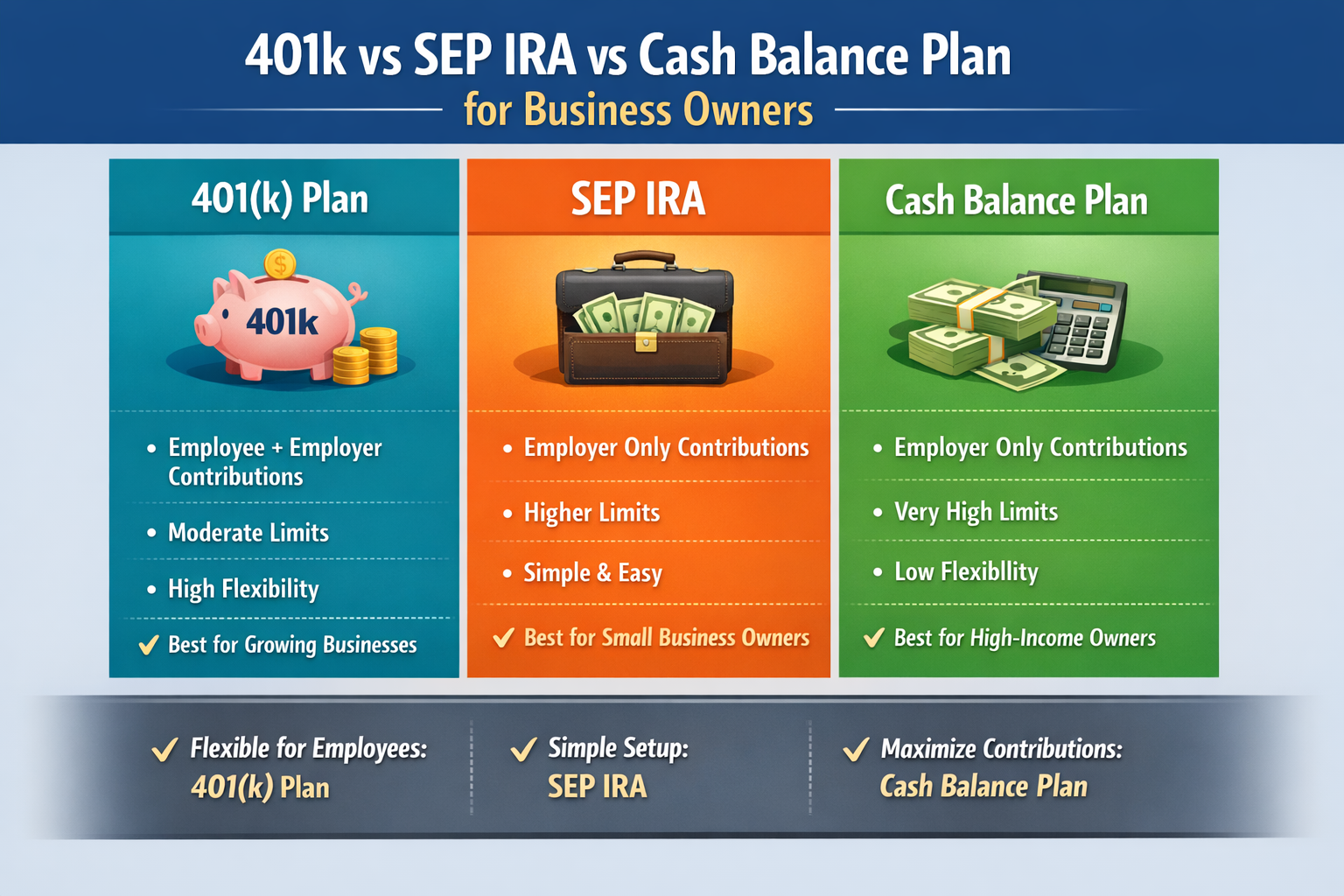
A 401(k) provides flexibility and allows both employee and employer contributions. A SEP IRA simplifies contributions but is employer-funded only. A Cash Balance Plan is more structured and allows significantly higher contributions, often appealing to higher-income business owners.
The right choice depends on your income level, business structure, and long-term financial goals.
Side-by-Side Comparison
Here’s how the three retirement plans compare:
401(k) Plan
- Contributions: Employee + Employer
- Contribution Limits: Moderate
- Flexibility: High
- Complexity: Moderate
- Best For: Growing businesses with employees
SEP IRA
- Contributions: Employer Only
- Contribution Limits: Higher than 401(k)
- Flexibility: Moderate
- Complexity: Low
- Best For: Small teams or solo business owners
Cash Balance Plan
- Contributions: Employer Only
- Contribution Limits: Very High
- Flexibility: Low Complexity: High
- Best For: High-income business owners seeking aggressive retirement savings
Quick Summary
- Choose a 401(k) for flexibility and employee participation Choose a
- SEP IRA for simplicity and ease of setup
- Choose a Cash Balance Plan for maximizing contributions and tax efficiency
When a 401(k) Makes Sense
A 401(k) plan is often the most versatile option.
It works well when:
- You want employees to contribute to their own retirement
- You prefer flexibility in contributions
- You are building a scalable benefits structure
It also allows for employer matching, which can improve employee participation and retention.
When a SEP IRA Is a Good Fit
A SEP IRA is designed for simplicity.
It may be the right choice if:
- You want minimal administrative complexity
- You are a solo business owner or have a small team
- You prefer making employer-only contributions
However, contribution requirements must be applied consistently across eligible employees.
A Different Perspective: Long-Term Strategy Matters
While it’s easy to compare plans based on contribution limits or simplicity, the real decision goes deeper.
Retirement planning for business owners is not just about saving—it’s about structuring wealth efficiently over time.
A plan that works today may not be the best option five years from now. As income grows and business structures evolve, the strategy should evolve as well.
This is why many business owners transition from simpler plans into more advanced structures as their financial situation becomes more complex.
When a Cash Balance Plan Becomes Powerful
Cash Balance Plans are often used by high-income business owners looking to accelerate retirement savings.
They are ideal when:
- You want to contribute significantly more than traditional limits
- You are focused on tax efficiency
- You have stable and predictable income
These plans require more structure and administration but can provide substantial long-term benefits.
Common Mistakes to Avoid
When choosing a retirement plan, business owners often:
- Focus only on contribution limits
- Ignore long-term tax implications
- Choose simplicity over strategy
- Fail to revisit the plan as their business grows
The result is often a plan that no longer aligns with their financial position.
The Role of a Retirement Plan Advisor
Working with a business retirement plan advisor helps ensure:
- The right plan is selected based on your goals
- Tax strategies are properly integrated
- The plan evolves as your business grows
This brings clarity to what can otherwise be a complex decision.
Final Thoughts
There is no single “best” retirement plan—only the one that fits your business and long-term financial strategy.
By understanding the differences between 401(k), SEP IRA, and Cash Balance plans, business owners can make more intentional decisions that support both growth and long-term wealth.
Post Disclaimer
All opinions and views expressed by Farther are current as of the date of this writing, are for informational purposes only, and do not constitute or imply an endorsement of any third-party’s products or services.
The information provided does not take into account the specific objectives, financial situation, or the particular needs of any specific person and therefore should not be relied upon as investment advice or recommendations. Neither does it constitute a solicitation to buy or sell securities, nor should it be considered specific legal, investment or tax advice.
Finally, investing entails risk, including the possible loss of principal, and there is no assurance that any investment will provide positive performance over any period of time.