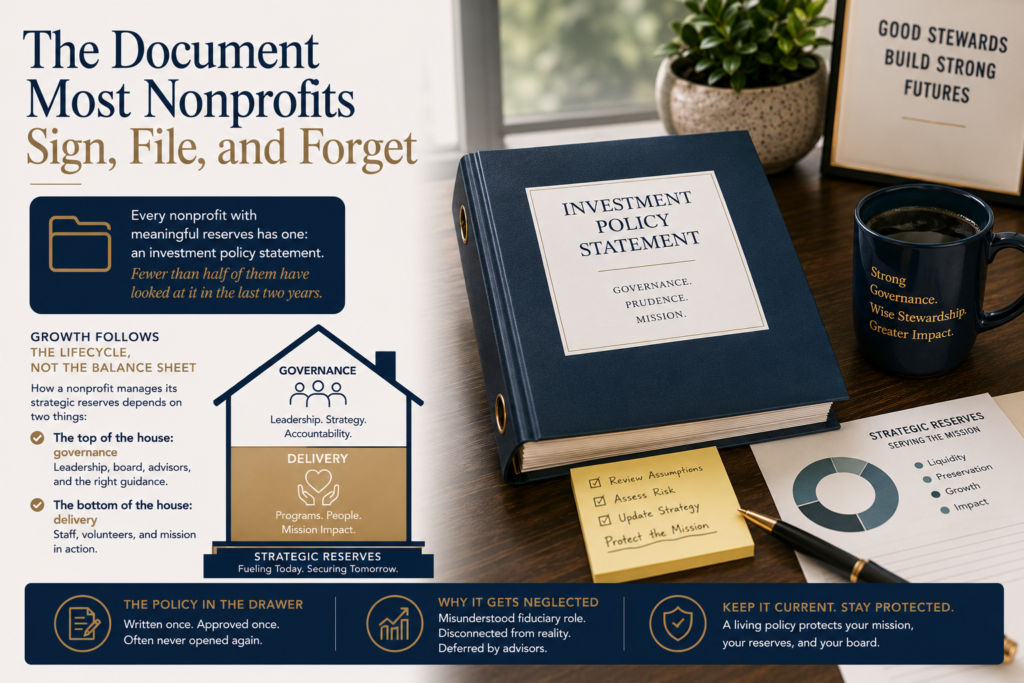
Every nonprofit with meaningful reserves has one: an investment policy statement. Fewer than half of them have looked at it in the last two years.
Growth Follows the Lifecycle, Not the Balance Sheet
How a nonprofit should manage its strategic reserves has less to do with the size of the fund and more to do with where the organization sits in its own development. Two things determine that: how the top of the house is structured, and how well the bottom of the house operates.
The top of the house is governance — the executive director, the founder, the board, any separate advisory group, and the outside consultants (legal, accounting) who support them. The bottom of the house is delivery — the staff and volunteers actually fulfilling the mission, whether that means filling food boxes, driving patients to treatment, or digging wells overseas.
Those two halves look completely different depending on the organization, but they have to function together. The condition of both — and where leadership wants to take the organization next — is what should drive every decision about how reserve capital is deployed. Excess capital exists to serve the mission. But how it gets deployed has to match the organization’s actual maturity, not an aspirational version of it.
The Policy in the Drawer
For nonprofits with enough capital to warrant one, the investment policy statement is supposed to be a living document — the framework that governs how reserves are managed and who’s accountable for that management. In practice, it’s often written once, approved once, and never opened again.
Two things tend to cause that.
First, many boards don’t fully grasp their fiduciary role or how much weight it actually carries. An investment policy statement isn’t paperwork — it’s the standard the board is legally and ethically held to. Treating it as a formality is where the real exposure starts.
Second, the policy needs to stay connected to economic reality — both the broad economic environment and the narrower microeconomic conditions the organization operates within. Markets shift. Funding sources shift. The organization’s own risk capacity shifts. A policy statement that doesn’t get revisited stops reflecting any of that.
Why It Gets Neglected
Part of the blame sits with the wealth managers advising these organizations. Updating an investment policy statement is real work — reviewing assumptions, re-running the numbers, walking the board through changes — and it doesn’t always feel like it pays off for the advisor’s time. So it gets deferred.
That calculation is wrong. Keeping the policy current isn’t overhead. It’s what makes the reserve strategy defensible, keeps the board’s fiduciary exposure in check, and keeps the mission funded on terms that still make sense today — not terms that made sense three or five years ago.
Fuest & Klein works with boards and leadership teams to build investment policy statements that hold up — and stay current as the organization changes. If your foundation’s reserves haven’t had a real review lately, that’s worth a conversation.
[Start a Conversation →] HERE
All opinions and views expressed by Farther are current as of the date of this writing, are for informational purposes only, and do not constitute or imply an endorsement of any third-party’s products or services.
The information provided does not take into account the specific objectives, financial situation, or the particular needs of any specific person and therefore should not be relied upon as investment advice or recommendations. Neither does it constitute a solicitation to buy or sell securities, nor should it be considered specific legal, investment or tax advice. Finally, investing entails risk, including the possible loss of principal, and there is no assurance that any investment will provide positive performance over any period of time.
Post Disclaimer
All opinions and views expressed by Farther are current as of the date of this writing, are for informational purposes only, and do not constitute or imply an endorsement of any third-party’s products or services.
The information provided does not take into account the specific objectives, financial situation, or the particular needs of any specific person and therefore should not be relied upon as investment advice or recommendations. Neither does it constitute a solicitation to buy or sell securities, nor should it be considered specific legal, investment or tax advice.
Finally, investing entails risk, including the possible loss of principal, and there is no assurance that any investment will provide positive performance over any period of time.